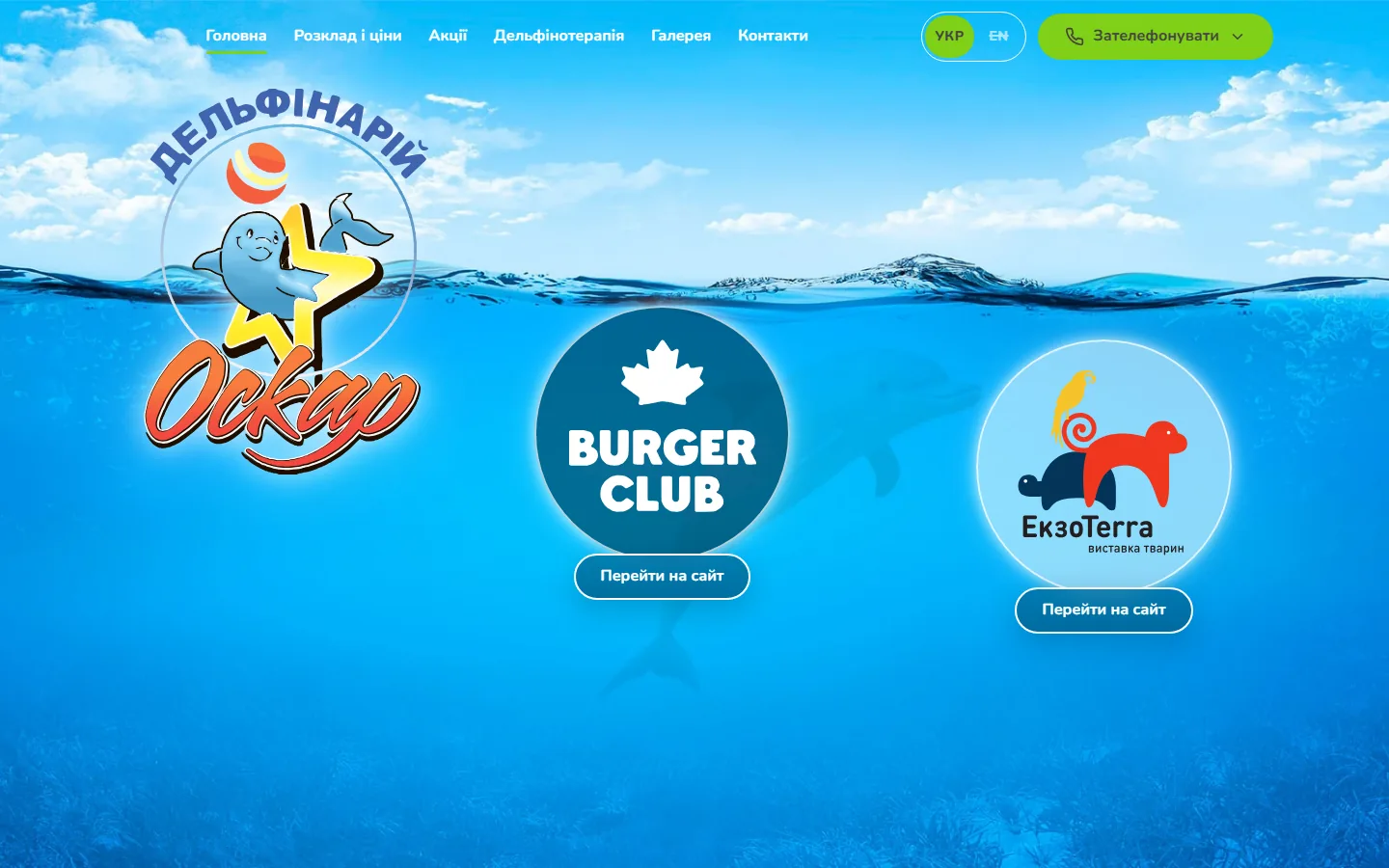
People planning a visit want the same few answers: what is on, when, how much and how to ask. Oskar, a dolphinarium complex in Truskavets, is the project behind this page, and it is still in progress.
Venue sites tend to collect buttons for things nobody uses. Eleven items filled the main menu of Oskar's old site, and some of them offered ticket actions that the complex does not provide online. A visitor who only wants the time of the next show has to guess which button is meant for them.
Prices that only a developer can change
On the old Oskar site the schedule and news were easy to edit, but prices and promotions were not. Prices that live in the code go stale, or wait until someone technical finds the time.
Several attractions, one entrance
A complex can hold several places with different looks and different visitors. Oskar includes a dolphinarium, a café and a terrarium, and each had its own site. People should choose where they are going before they land inside one of them.
An old base nobody wants to touch
A technical base that is hard to maintain makes every change slow. The old site also lacked basic search markup: no sitemap, no canonical or hreflang tags and no structured data.
What the website does for a venue
The aim is a lighter site that the venue's own team can keep up to date.
An entry screen where visitors choose the attraction they came for, or a short menu that merges schedule, prices and services on one page.
Direct call buttons with the phone numbers, for visitors who would rather speak to someone than leave a call-back request.
An admin panel where your team edits the schedule, the prices and the promotions, with an archive of finished promotions. In the Oskar project this panel is planned, not yet delivered.
Request forms that collect only what is needed. The Oskar plan includes a dolphin-therapy request form that gathers no medical data.
A Ukrainian version and an English one, together with the basic search markup the old site was missing.
A design built on the venue's own brand colours, with text contrast checked against WCAG 2.1 and documented.
The case: Oskar (in progress)
Oskar, a dolphinarium complex in Truskavets
Oskar combines a dolphinarium, the Burger Club café and the EkZoterra terrarium. The design system and a static mockup are finished, and five of its pages carry the client's approval. The production build on Laravel and Filament is in progress, so the new site is not live and the admin panel is planned, not delivered. The screenshot shows the design mockup, not the production site.
A venue that has to keep prices, schedules and promotions current is the clearest match for a website with an admin panel. A venue whose information rarely changes can start with a business website, and an existing site that has grown unwieldy suits a redesign, which is how the Oskar project began. The panel is a separate part of the scope, so you decide whether you need it.
The size of the job depends on how many attractions share the site, which languages you need and what the panel should edit. Once we have spoken, you get a single fixed quote for the agreed scope, and the contract carries that figure.
Questions from tourism and entertainment venues
Can staff change prices and the schedule without a developer?
That is the purpose of an admin panel. In the Oskar plan the client edits the show schedule, ticket and service prices and promotions. Because that panel is still being built, I describe it as planned, not as delivered.
Can one site cover several attractions?
It can, or each attraction can stay a separate site with its own address and look, as the two smaller Oskar sites do. We choose on the call.
Do you sell tickets online?
Only if the venue offers that. The Oskar complex does not sell tickets online, so the redesign removes those buttons. Online ticketing would be a separate part of the scope.
Will the site have Ukrainian and English versions?
Yes. For Oskar, the main site is planned in Ukrainian and in English, along with basic search markup.
Guarantees
Two promises I always keep
Fixed price in the contract
The price is written into the contract before work starts. You get the quote after a short call, once the scope is clear.
Everything in your name
Domain, hosting, code and every access are in your name. The site stays yours, whoever works on it next.
Describe your project
Tell me about your business and what you need. A short call follows, then a fixed quote.